Flexibility and Security:
Gig Worker Needs and Aspirations in Flint and Genesee County
Research Brief | August 2026
University of Michigan-Flint, Institute for Society and Technology
University of Michigan-Ann Arbor, Michigan Metro Area Communities Study



Key Findings
- 46% of respondents said gig work is important or essential to meeting their basic needs.
- Only 8% of respondents believe they are part of the gig economy, but roughly 22% had engaged in gig work.
- Gig workers are nearly twice as likely (48%) as non-gig workers (23%) to report a desire to go back to school for additional training.
About This Research
This report is based on research conducted by the Institute for Society and Technology (IST) and partners at the Michigan Metro Area Communities Study (MIMACS). The Flint and Genesee County survey was conducted between March 3, 2026, and May 26, 2026. The survey reflects the views of a representative sample of 1,021 respondents from Genesee County. Respondents, both gig- and non-gig workers, provided their opinions on employment, experiences with gig work, education and training, fairness and economic inequality, digital accessibility, demographics, and economic beliefs.
This research is among the first representative surveys of this growing segment of the labor market. More than one in five residents (22%) have engaged in gig work, yet relatively little is known about their reasons for entering the gig economy, their economic struggles, and their interest in future educational or training opportunities. Flint’s decades-long decline in manufacturing employment makes it an instructive case for understanding how gig work is reshaping traditional labor markets and how app-based employment intersects with residents’ broader labor market experiences.
“Gig workers” were defined as respondents who had ever earned income through app- or platform-based activities, including: driving for ride-hailing apps such as Lyft or Uber; shopping for or delivering groceries or other items through platforms such as Amazon Flex or Instacart; performing household tasks through an app such as TaskRabbit or Angi, delivering restaurant orders through DoorDash or UberEats; performing survey work or online tasks through apps such as Amazon Mechanical Turk; providing care for family members or pets through platforms such as Rover or Care.com; or undertaking freelance or contract work through platforms such as Upwork.
Overview
Platform and app-based work reflects a significant and growing segment of the labor market in Michigan and across the United States.1 2 Many residents engage in gig work to meet basic needs, while others do so to earn discretionary income. This report finds that gig workers express satisfaction with the flexibility of platform and app-based work, but many are concerned about pay, transparency, benefits, and protections.
Overall, gig workers view their experience in the gig economy as broadly positive. Among those who earned income through the gig economy over the last year, more than two-thirds (67%) felt very or somewhat positive about the experience. Still, more than four in ten gig workers were dissatisfied with the pay they received per job, while nearly half (46%) said that gig work was essential or important to meeting their basic needs, suggesting that many gig workers may be economically precarious.
Gig Workers Are Diverse and Do More Than Ride-Hailing
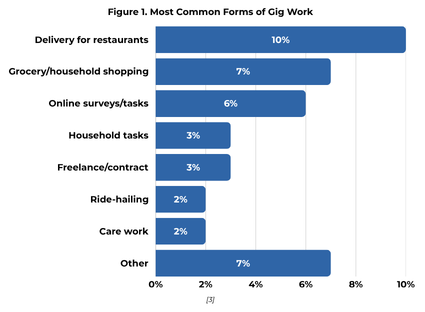
While only 8% of respondents believed they were part of the “gig economy,” a far greater number had ever earned income from gig-work platforms. Overall, 220 respondents (roughly 22%) had engaged in gig work. This suggests that many respondents who have worked in the gig economy do not see themselves as “gig workers.”
Gig workers are diverse in terms of their educational trajectories. Nearly 60% of gig workers have education or training beyond high school. More than one in five (22%) have a bachelor’s or master’s degree.
Among all respondents, the most common forms of work were restaurant delivery and grocery or other household shopping delivery.
Gig Workers Report Broadly Positive Experiences
- Overall, gig workers viewed their experiences positively. More than two-thirds (68%) evaluated their experiences as very or somewhat positive.
- Only one in eight (12%) described their experience as very or somewhat negative.
For Many, Extra Income Helps Meet Basic Needs
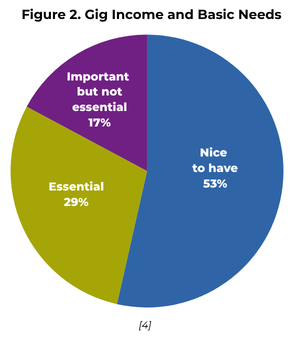
- Gig workers were divided on the importance of gig work in making ends meet. A majority (53%) viewed gig work income as “nice to have”; a supplement to traditional employment rather than as a replacement.
- Few gig workers (6%) left another job or reduced their hours when they entered the gig economy.
- However, a significant minority (46%) of gig workers reported that gig work was important or essential, suggesting it may be supplemental rather than optional.
Gig Workers Are Concerned About Pay, Fairness, and Algorithms
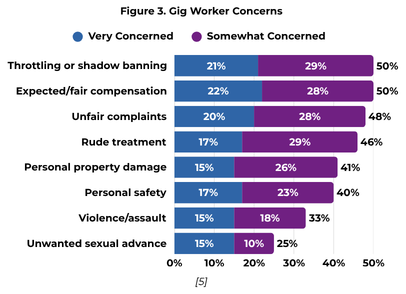
- Although gig workers report broadly positive experiences, pay remains a critical concern. Overall, nearly half (44%) expressed dissatisfaction with the amount paid for each job. Around one in three (33%) were satisfied.
- Half of gig workers (50%) were concerned about being denied expected or fair compensation, and nearly half (48%) reported concern about unfair complaints. User complaints are often a decisive factor in visibility algorithms, and half (50%) of gig workers felt concerned with throttling or shadow banning.
- Gig worker concerns about pay transparency are mixed. While six in ten (62%) said that it was somewhat or very clear how they were paid, nearly four in ten (38%) believed it was not sufficiently clear.
Dissatisfaction With Pay Did Not Necessarily Result in Dissatisfaction With Gig Companies
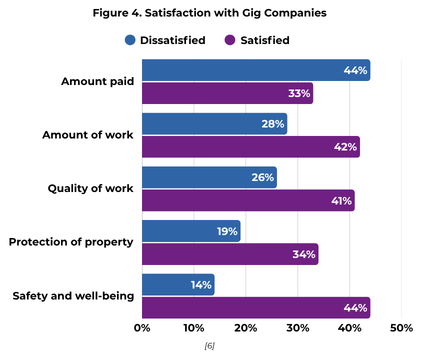
- Gig workers felt more satisfied than dissatisfied with the amount and quality of the work they were offered.
- Respondents were more divided in their views on gig companies’ role in the amount paid, with close to half (44%) reporting dissatisfaction.
Benefits and Protections
- Among gig- and non-gig workers, support for additional benefits, security, and protections for gig workers was strong. More than half of respondents supported health care subsidies, paid sick leave, unemployment benefits, childcare support, retirement contributions, and a minimum earnings guarantee.
- Gig workers reported higher support for a minimum wage guarantee (70%) compared to non-gig workers (60%), and for a portable benefit that could be used across platforms (61% vs. 55%).
- Gig workers did not report greater support for health insurance subsidies, unemployment insurance, paid sick leave, retirement contributions, or childcare benefits than non-gig workers.
What Distinguishes Gig Workers?
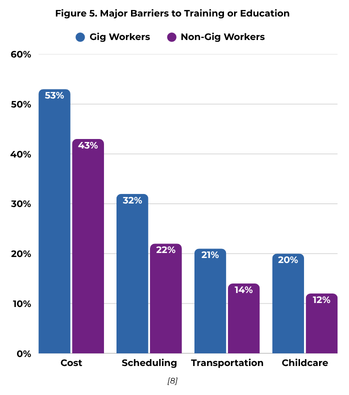
Cross-tabulations reveal key differences between gig and non- gig workers in educational priorities, attitudes toward flexible work, financial strain, and the value of gig work for earning extra income.8
- Gig workers were nearly twice as likely (48%) as non- gig workers (23%) to report a desire to go back to school for additional training.
- A larger share (90%) of gig workers believed that gig work was a way to earn extra money, compared with non-gig workers (74%).
- Nine in ten (90%) gig workers believed gig work was “great for people who want flexible schedules,” compared to two-thirds (68%) of non- gig workers.
- Gig workers were more likely to report that cost, childcare, transportation, and scheduling were “major barriers” to obtaining additional training or education.
Demographics
- Gig workers were less likely than non-gig workers to earn more than $100,000 (21% vs. 31%).
- Gig workers were nearly twice as likely to identify as Hispanic (7.6% vs. 3.9%).
- Gig workers were less likely to have any post-secondary education (55% vs. 62%).
- Gig workers were more likely to be born outside the U.S. (5.3%) than non- gig workers (2.2%).
- 1 Pew Research Center. The State of Gig Work in 2021. Available at https://www.pewresearch.org/internet/2021/12/08/the-state-of-gig-work-in-2021/ ↩︎
- 2 Federal Reserve. Report on the Economic Well-Being of U.S. Households in 2024 – May 2025. Available at https://www.federalreserve.gov/publications/2025-economic-well-being-of-us-households-in-2024-employment-and-gig-work.htm ↩︎
- 3 Fig. 1: “Please indicate whether you have ever earned money through gig work using each of the following mobile apps or websites” ↩︎
- 4 Fig. 2: “Which of the following statements best describes the income you have earned from gig work obtained through apps or websites over the past 12 months?” ↩︎
- 5 Fig 3: “How concerned are you about each of the following while doing gig work obtained through apps or websites?” ↩︎
- 6 Fig. 4. “How satisfied are you with the way the companies that run the gig work apps or websites you have used have handled each of the following?” ↩︎
- 7 Fig 5: “How much of a barrier, if any, is each of the following to your ability to pursue additional education or training?” ↩︎
- 8 Note on subgroup comparisons: Cross tabulations show important differences between gig and non-gig workers. However, because some subgroup sample sizes are small, these estimates suggest more uncertainty. They can be understood as suggestive of broader patterns but reflect a lower level of confidence. ↩︎