Policy and Procedure Manual
General Information
Introduction
The goal of the School of Nursing Center for Simulation and Clinical Innovation is to provide a safe learning experience that promotes a successful understanding of all aspects of health care.
The goal of the CSCI staff is to provide a realistic, effective, and efficient environment for teaching and learning. Simulation scenarios are designed to help the student develop problem-solving and clinical decision-making skills. The CSCI will attempt to include all environmental factors to make the students’ learning experience realistic and authentic. For enhanced learning, all students are expected to come to the center prepared. The faculty will provide students with pre-learning materials and pre-briefing prior to their Simulation-Based Experience and will offer opportunities for reflection with structured feedback and debriefing immediately after the SBE to promote self-reflection and the development of clinical reasoning.
The following information is to ensure quality and safety while using the CSCI. It is expected that all faculty, staff, and participants involved in the classroom, clinical skills, remediation, and simulation activities will adhere to these guidelines. Members of the CSCI will update the contents of this manual when necessary. All faculty, staff, and participants will be able to access the most current version, complete with any revisions, of this CSCI Policy and Procedure Manual on the CSCI website at the Center for Simulation & Clinical Innovation.
Mission
The University of Michigan-Flint CSCI is dedicated to excellence in healthcare education by advancing patient safety, improving interprofessional communication, teamwork, and clinical performance through state-of-the-art Simulation-Based Experiences and research. The mission of the CSCI is to provide high-quality SBEs for future healthcare professionals, focusing on evidence-based, culturally competent, collaborative interprofessional patient-centered care, thus improving patient safety and health outcomes.
Vision
The UM-Flint School of Nursing will be a leader in the innovative use of simulation-based education technologies for nursing and interprofessional healthcare education. This will be accomplished by:
- Offering a safe multi-modal simulated learning environment for learning, where high-quality, safe patient care is emphasized through the utilization of evidence-based clinical decision-making.
- Competency-based assessments of our learners.
- Fostering collaborative partnerships between disciplines both within the University of Michigan Flint and the local community to facilitate the development of interprofessional teamwork and communication skills.
- Advancing the science of simulation-based education by contributing to the growing body of knowledge supporting the role of simulation in healthcare education and improved patient outcomes.
Governance
Ultimately, the CSCI is governed by the Regents of the University of Michigan. Locally, the CSCI is governed by the Dean of the SON. The Director of the CSCI reports directly to the Dean of the SON. Provided below is the link to all the University of Michigan’s organizational and governance structure charts. These charts are living documents and will be updated by a representative of the University of Michigan when required. For more information, please follow the link provided for SPG Organizational Structure
Decision-Making Process
All decisions are made in the best interest of the CSCI and, ultimately, the SON. Please see “Administrative Information” below.
Required Disclaimers and Pre-Event Statements
Program Leads agree to have and be present at a Pre-Program Planning Meeting where all details of programs will be discussed and verified in the presence of a representative of the CSCI.
UM-Flint Brand Promise
UM-Flint provides an excellent Michigan education with a unique perspective. As an integral part of Flint’s vibrant downtown, UM-Flint offers students the rare opportunity to use what they’re learning to solve problems and have an immediate, positive effect on the community and the lives of people who live here (Flint, MI), as well as the world beyond. We are proud of the community we call home, its history, and the remarkable accomplishments Flint has already achieved. As members of this community, we share its spirit of resilience, tenacity, and innovation and actively seek students who embrace and confront challenges with creativity, courage, and compassion. Our students build on their diverse talents and passions to emerge with exceptional problem-solving skills, valuable career-related experiences, a broader understanding of complex issues that shape communities, and the ability to rise to any challenge. With these qualities and experiences, our students are singularly prepared to put their outstanding University of Michigan degrees to work.
Simulation Facility “Brand” Use Policy
All branding and messaging usage, image, print, and advertisements must first be approved through the Office of University Relations at 500 Northbank Center: 303 E. Kearsley Street Flint, MI 48502 810- 237-6570, email at Dept.UREL@umich.edu.
For more information, please follow the link provided below. UM-Flint Brand Tool Kit
Hours of Operation
The CSCI has normal business hours, Monday through Friday, from 8 a.m. to 5 p.m. The CSCI has the potential to flex these hours to accommodate Classes, Programs, Meetings, Simulations, or Events outside of its normal business hours. These deviations from normal business hours will be tentative upon written approval from the Director of CSCI. Every effort must be made to avoid scheduling outside of the normal business hours before consideration will be taken for a request. Once a deviation is approved, it will be reflected on the Google calendar appointment reservation. Final approval will be from the Dean of the SON. The CSCI will close to all users on official university-designated holidays. The CSCI follows the university’s academic calendar.
Locations
The CSCI is located at:
University of Michigan-Flint
School of Nursing
Center for Simulation and Clinical Innovation
William S. White Building
509 Harrison Street
Flint, MI, 48502
First Floor CSCI, Room 1106
First Floor CSCI, Room 1124
Second Floor CSCI, Room 2203
Thirs Floor CSCI, Room 3148
CSCI Terminology
The CSCI has adopted verbiage and terms of the Society for Simulation in Healthcare’s Healthcare Simulation Dictionary. This dictionary and its terms are a living document, and the terms and definitions will change and be edited, added, or deleted over time.
Food & Beverages
In order to preserve costly simulation equipment, food and beverages are restricted around the Human Patient Simulators (HPS) in all spaces within the CSCI, on the first, second, and third floors. Food and beverages are permitted in all debrief rooms/spaces of the CSCI.
Personnel
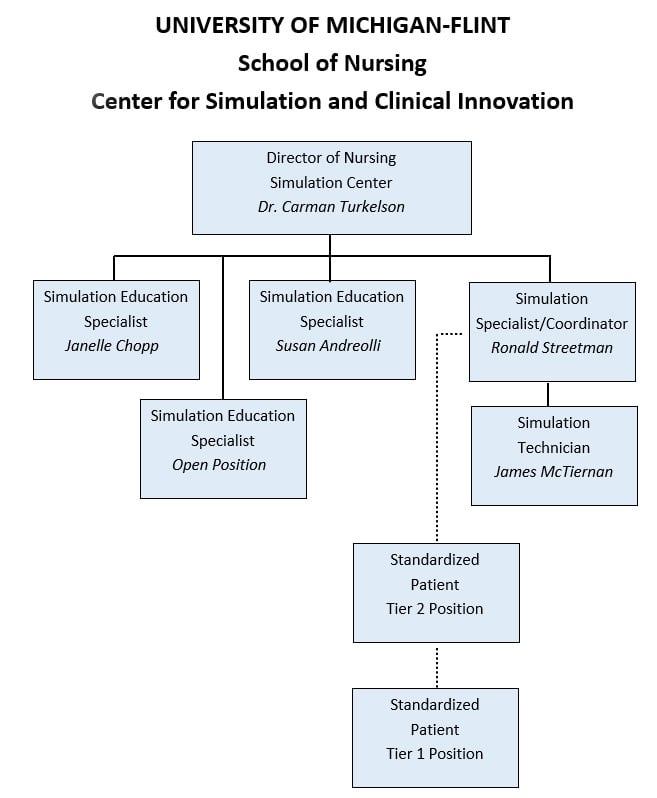
Director of Nursing Simulation Center
The Director of the CSCI is responsible for creating a shared multi-year programmatic vision in coordination with key stakeholders and for planning, designing, implementing, and evaluating SBEs across the curriculum in all programs. The primary responsibilities of the position include faculty development, future planning, marketing, and guiding the use of simulation for research. The Director will also be responsible for identifying opportunities for improvement, innovation, research, and managing the implementation of change initiatives for the integration of SBEs into student education.
Assistant/Associate/Professor of Nursing
SON Faculty with simulation expertise (CHSE or CHSE-A) may also support the CSCI with clinical skills activities and simulation-based experiences by providing students and faculty with appropriate resources to complete evidence-based learning opportunities in a simulated patient care environment. Assists with training and mentoring faculty in the use of simulation equipment and in the design and development of simulation-based experiences. These individuals may also participate in and assist with research, tours, and other CSCI educational offerings for internal/external groups and/or individuals. Assists in the development and implementation of short, intermediate, and long-term teaching and research goals for the CSCI.
Simulation Education Specialist
Supports the CSCI with all SBEs and clinical skills activities by providing students and faculty with appropriate resources to complete evidence-based learning opportunities in a simulated patient care environment. Assists with training and mentoring faculty in the use of simulation equipment and in the design and development of SBEs. Participates and assists with SBEs, research, tours, and other simulation-related educational offerings for internal/external groups and/or individuals. Assists Director and Assistant/Associate Professor in the implementation of short, intermediate, and long-term teaching and research goals for the CSCI.
Simulation Specialist/Coordinator
The Simulation Specialist/Coordinator assists the CSCI with all activities surrounding simulation events. This role works closely with the Director of the CSCI and Simulation Technician to produce high-quality education activities. This position supervises Simulation Technicians, Standardized Patients, and Student Temporary workers and is involved in hiring, training, and ongoing day-to-day supervision. The Simulation Specialist/Coordinator coordinates the daily operational activities of CSCI, including scheduling of CSCI space, standardized patients, open student learning sessions, equipment, tours, assists with the development and revision of CSCI policies, oversees the standardized patient utilization, scheduling, payment and works with the Director and Assistant/Associate Professor in the development and implementation of short, intermediate, and long term teaching and research goals for the CSCI.
Simulation Technician
The Simulation Technician supports the CSCI with all clinical skills activities and all SBEs by providing students and faculty with appropriate resources to complete evidence-based learning opportunities in a simulated patient care environment. This position assists in role-playing applications, prop placement, and moulage set-up to create a virtual health care environment and experience. This role primarily operates the human patient simulators and programming of the HPS software and/or other CSCI software for any SBE. The Simulation Technician is responsible for setting up simulation activities, assisting with the creation and application of scenario moulage, breaking down and storage of all the simulation equipment and cleaning the CSCI as needed following SBEs or other educational activities, purchasing disposable supplies, and maintaining a clean, fully equipped CSCI.
Standardized Patient – Tier 1 & Tier 2
Standardized Patients at both tier levels are personnel specially trained to accurately and consistently recreate the history, personality, physical findings, and emotional structure and response pattern of an actual patient at a particular point in time; assess/document learner performance; provide individualized feedback on interpersonal skills as indicated; represent patient satisfaction. In this capacity, an SP will be interviewed and physically examined by learners or health professionals in the same manner that would occur if they were an actual patient. Additional training is provided to select Standardized Patients to provide individualized feedback on interpersonal skills. Additional responsibilities include simulating a patient case and, with guidance from the CSCI faculty providing feedback for health providers at multiple levels (undergraduate, postgraduate, and practicing providers) related only to their interpersonal communication skills.
Administrative information
Support Staff
The CSCI staff is outlined below.



Simulation Education Specialist (Grant Funded Position):
Open Position

Standardized Patient – Tier 2; Seasonal:
Totaling 15 Persons, as of 08/01/2025
Standardized Patient – Tier 1; Temporary:
Totaling 8 Persons, as of 08/01/2025


Scope of Work/Description for Each Personnel Classification
See “Personnel” above.
Overtime Policy
Any and all overtime must be approved in writing by the Dean of the SON. Any requests for overtime must be accompanied by a written request and an explanation as to the need for this overtime. No Class, Program, Meeting, Simulation, or Event will be scheduled in advance of this overtime approval outside of normal business hours. Also, see the University’s Standard Practice Guide Policy 201.38 for official overtime.
Organizational Chart
The CSCI organizational chart is displayed below.
Course Directors and Instructors
Instructor Training
The CSCI requires all Lead Faculty and Clinical Faculty facilitating SBEs within the CSCI to complete ongoing faculty development modules focusing on best practices in clinical simulation. For Faculty and Clinical Faculty that will be utilizing specialized equipment and task trainers (MDS or Virtual Reality Foley), they will receive individualized training prior to scheduled simulation sessions.
Required Proof of Ongoing Professional Development Prior to Scheduling Simulations
Consistent with the Healthcare Simulation Standards of Best Practice ™, the CSCI requires all faculty facilitating SBEs, or other experiential learning, or assessments within the CSCI complete or document ongoing professional development in simulation pedagogy. This documentation must be provided to a member of the CSCI team prior to submitting scheduling requests, via Google form process. Faculty may demonstrate professional development in a variety of ways including, but not limited to:
- Online Simulation-based webinar or professional development activity.
- Attendance at a professional conference related to simulation.
- Other low-cost or free online resources found on the CSCI Intranet.
More information on how to access these faculty development modules is available on the CSCI intranet website under “Faculty Development.” Also, see the “Instructor Training” above
Code of Conduct
The CSCI holds both faculty and staff to the highest standards of professionalism while present in the CSCI. Clinical and non-clinical faculty are expected to abide by the University’s Professional Standards as detailed in Standard Practice Guide Policy 201.96.
Code of Ethics
The CSCI also asserts that all faculty and staff of the CSCI shall recognize and abide by the Society for Simulation in Healthcare’s “Healthcare Simulationist Code of Ethics.” This Code of Ethics asserts key aspirational values important to the practice of clinical simulation:
- Integrity
- Healthcare Simulationists shall maintain the highest standards of integrity, including honesty, truthfulness, fairness, and judgment in all matters affecting their duties.
- Transparency
- Healthcare Simulationists shall perform all healthcare simulation activities in a manner that promotes transparency and clarity in the design, communication, and decision-making processes.
- Mutual Respect
- Healthcare Simulationists shall respect the rights, dignity, and worth of all. They shall practice empathy and compassion to support beneficence and non-maleficence towards all involved in simulation activities.
- Professionalism
- Healthcare Simulationists shall conduct themselves in a manner that upholds the professional standards inherent in healthcare simulation.
- Accountability
- Healthcare Simulationists shall be accountable for their decisions and actions in fulfilling their duties and responsibilities.
- Results Orientation
- Healthcare Simulationists shall serve to support activities that enhance the quality of the profession and healthcare systems. Outcomes are inclusive of all parts of the process of healthcare simulation and are not exclusive to a final product.
Dress
The UM-Flint faculty and CSCI staff are also held to a high standard of professionalism by presenting themselves at all times with business casual attire, UM-Flint SON scrubs, or white lab coats. Also, see the University’s Standard Practice Guide Policy 201.05 work rules and conditions policy.
Course Development Policy
Any course, program, clinical simulation scenario, or educational event created by or offered in the CSCI will be developed and supported by best practices in simulation and/or evidence-based research in an effort to promote critical thinking and realism. Any course, program, clinical simulation scenario, or educational event developed by Faculty or Clinical Faculty with the assistance of the CSCI will be added to the CSCI collection library and made available to all faculty, staff, and partners of the SON. The CSCI endorses and requires the use of the National League of Nursing (NLN) Simulation Design Template for the design and creation of any new simulation scenarios. This template is available on the CSCI website.
Evaluation Policy
The CSCI participates in ongoing program evaluation. Evaluations are solicited from Learners/Students/Participants for each Program, Class, Simulation, or Educational Event that takes place within the CSCI. The CSCI will develop an action plan to ensure quality and provide an opportunity for improvement when required. In the event an action plan is required, it will be developed in collaboration with the course Lead Faculty and the CSCI. The CSCI participates in ongoing quality improvement utilizing adherence to the Healthcare Simulation Standard of Best Practices™.
Members of the CSCI will perform an ongoing review and provide feedback to the Lead Faculty based on CSCI policies, procedures, and the HSSOBP, as well as review outcome data related to the evaluation feedback received from students who have participated in simulation scenarios.
The CSCI solicits SBE feedback from students and participants via the Simulation Effectiveness Tool – Modified (SET-M) evaluation form. Additional evaluation metrics can be integrated into the Modified Set-M form at the request and discretion of the course Lead Faculty. A summary of this feedback will be provided to the course Lead Faculty at the end of each semester. In the interim, Faculty can request evaluation summaries at any point in the semester by contacting any member of the CSCI team.
The Simulation Effectiveness Tool – Modified (SET-M) evaluation form is available on the CSCI Intranet website.
Course Registration
Upon arrival at the CSCI for any Class, Program, Meeting, Simulation, or Event, all participants, regardless of student type and including faculty, are required to sign in via the CSCI swipe-in process. This process provides the UM-Flint student and faculty the ability to swipe their university-issued UMID card to record their attendance at the Class, Program, Meeting, Simulation, or Event held within the CSCI. This process allows the CSCI to properly track utilization numbers of the CSCI. Also, see “Schedule Course and Room” below.
Equipment Utilization
Any and all simulation equipment in the CSCI is solely for the use of educating and training. No single or collection of equipment stored or housed in the CSCI shall be used in conjunction with any community events, where CSCI equipment may be used with or on real live human subjects. This policy is in place to protect the interest of the SON and is strictly enforced to guarantee the wellbeing of the community, faculty, staff, and students from any danger associated with treatment or assessment done by non-calibrated, non-inspected, or non-functioning medical equipment or devices.
Instructor Travel
The university has established policies and procedures for travel and business hosting expenses (Travel and Business Hosting Expense Policy 507.10-1) that enables the university to effectively comply with federal and state regulations. These policies and procedures apply to reimbursements from all university funding sources. Non-compliance could result in the university being subjected to financial risks such as tax assessments, penalties, and interest. Therefore, the university may not reimburse faculty, staff, and others for expenses that are not in compliance with university policies.
It is the expectation that the university traveler utilizes the university’s electronic travel and expense system when booking business travel; this increases efficiency when reporting expenses, as well as a number of other benefits that can be found on the Procurement Services website. Also, university discounted rates are available when booking business travel through the university’s travel and expense system or when using the designated travel agency. The university’s travel and expense system offers mobile functionality to enhance the traveler’s experience. Information regarding university travel can be found on the Procurement Services website.
Course Participants
Course Preparation
Learners/Students/Participants shall prepare for any and all programs, simulation experiences, or skills sessions in advance of their assigned date and time.
Learners/Students/Participants are expected to be on time, in proper dress code with UM identification badge, and follow the general rules of Professional Engagement while in the CSCI.
Please also refer to your course-specific Syllabus and/or to your Undergraduate or Graduate Nursing Student Handbook; links are provided for reference below.
- Undergraduate Nursing Student Handbook
- RN to BSN Nursing Student Handbook
- Graduate Nursing Student Handbook
Code of Conduct
In order to promote a distraction-free structured learning environment and a meaningful simulated experience, the following rules will be followed by each Student/Participant that chooses to participate in any learning opportunity within the CSCI:
- I will treat the CSCI like a real clinical environment.
- I understand that mistakes made in the CSCI are considered learning opportunities.
- In order to improve my clinical reasoning and enhance my learning experience, I will treat all experiences and interactions in the CSCI as though it is a REAL situation and/or patient!
- In order to get the most out of the Simulation-Based Experience (SBE), I will complete any pre/post-assigned learning activities.
- I will follow the UM-Flint School of Nursing dress code for clinical learning when attending SBEs in the CSCI.
- I will not have food or beverages outside of the CSCI conference areas or debrief rooms.
- I understand that students are not authorized to remove the supplies from the CSCI for any reason. Further, I understand that students who violate this instruction will be subject to the Student Conduct Policy.
- Any feedback I give to peers will be constructive in nature and intended to support others in the development of skills, critical thinking, and professionalism.
- I understand that I may be required to complete a post-simulation evaluation.
- I understand that the defibrillators in the CSCI deliver REAL energy.
General Rules of Professional Engagement in the CSCI
- I will turn OFF my cell phone while participating in any SBE unless otherwise approved by my faculty.
- I will never use excessive force with the human patient simulators or patient care equipment.
- I will dispose of all used sharps in an approved sharps container.
- I understand that I am not to wear shoes while lying on a stretcher or bed.
- I realize that all of the human patient simulators are allergic to something. I will acknowledge
the signs in each simulation room.
- I understand that ink pens are not permitted in the simulation spaces in the CSCI.
Disruptive Participants
Any perceived disruptive Learners/Students/Participants may be removed at the discretion of the Lead Faculty, Clinical Faculty, Course Facilitator, or CSCI Faculty or Staff. If the Lead Faculty is not present during the disruptive situation, the Lead Faculty will be notified of the situation. In the event that additional follow-up is required, the Lead Faculty will be responsible for the follow-up and any subsequent repercussions as a result of the situation.
Dress
In order to promote a structured learning environment and a student’s professional development, the CSCI mandates that Learners/Students/Participants will adhere to the clinical dress code for their current course while in the CSCI. Learners/Students/Participants are expected to follow the UM-Flint SON dress code for clinical learning when attending SBE in the CSCI.
Nursing uniforms, UM-Flint SON scrubs, or course-specific attire is required for all activities held within the CSCI.
Additional requirements are provided in the “Dress Code for Clinical Experiences – Pre-Licensure BSN Students” section on pages 14 and 15 of the Undergraduate Nursing Student Handbook. The link is provided below: Undergraduate Nursing Student Handbook
Also, see the University’s Standard Practice Guide Policy 201.05 “Work Rules and Conditions” policy as it applies to all Faculty and Staff.
Confidentiality Agreement
The faculty of the SON has deemed the clinical simulation scenarios to be of great significance for assisting the student to assess his/her basic competencies for readiness to practice as a Graduate/Registered Nurse or Advanced Practice Nurse (APRN). In order for each student to attain the fullest benefit from the clinical simulation scenario, the faculty requests no outside discussion of any simulation activity (including skills, games, testing, or scenarios) to take place with fellow students or future students. All activities in the CSCI are confidential, and as such, each Learner/Student/Participant is asked to agree to and abide by a confidentiality agreement.
The SON requires that each student complies with the CSCI Confidentiality Agreement. As a student in the SON at UM-Flint, you understand the significance of confidentiality with respect to information concerning onsite clinical scenarios, standardized patient scenarios, virtual scenarios, and fellow nursing students. Simulation-Based Experiences (SBE) are significant in assisting the faculty in assessing the competencies of nursing students while providing unique learning opportunities to support students in meeting course objectives. In order for each student to attain the fullest benefit from the SBEs, the SON requires that no discussion of SBEs take place with fellow students or future students including all educational events. Further, the SON asks that you report any violation of this Confidentiality Agreement that you become aware of to your course faculty or to any CSCI faculty or staff member.
The CSCI Confidentiality Agreement is as follows: I agree that, in order to participate in simulation learning, I will comply with the CSCI Confidentiality Agreement, and I understand that it is a breach of confidentiality to discuss any part of the activities involving SBEs with fellow students or future students.
This statement is also available in the “CSCI Confidentiality Agreement” section on page 22 of the Undergraduate Nursing Student Handbook.
Participants with Physical Limitations
Students/Participants with any physical limitations shall report said limitations to their lead faculty, course instructor, clinical instructor, and/or preceptor as soon as possible so that necessary precautions may be taken.
Medical clearance is required before Students/Participants with physical injuries, recent illness, recent surgeries, pregnancy restrictions, or communicable diseases will be allowed to participate, practice or return demonstrate any skill or procedure in an SBE.
It is the responsibility of the Lead Instructor, Clinical Faculty, or Preceptor to determine whether a Student/Participant with any physical limitation is capable of safely performing or participating in the simulation or skills practice.
Also, see U-M Standard Practice Guide Policy 201.35 “Non-Discrimination Policy” as it applies to all Faculty and Staff.
Cell Phone Usage
Personal cell phone usage is only allowed in the CSCI debrief rooms and is only encouraged for use with the CSCI sign-in and program evaluation process. Cell phones and other electronic devices, such as iPads and tablets, are permitted for the education of our students and learners. However, participants must turn OFF cellphones while participating in the actual SBE unless otherwise approved by the faculty. Such usage during the SBE has the potential for serious disruption of an educational or assessment session and the potential for violating FERPA regulations.
Scheduling Courses and Rooms
Approval Process
Class, Program, Meeting, Simulation, or Event space requests are evaluated on the program documentation that is submitted to the CSCI team. Once all of the required information is submitted and reviewed for space, equipment, staffing, and task trainer/simulator availability, the program is placed on the CSCI Google room calendar. This room reservation is then forwarded to the requestor and will serve as their confirmation of the room, time, equipment, and location they have reserved.
Scheduling Process
All CSCI Classes, Programs, Meetings, Simulations, or Events must be requested via the Google request form process. The Google request forms are located on the CSCI internal intranet website, link provided below. Once completed and submitted, the request form will be sent directly to the Simulation Team for immediate review. During review, proper attention and consideration will be given to the date, time, space, and equipment required to meet your learning objectives and the needs of your students/participants. Once your program is confirmed, you will receive a Google Calendar invitation from the room(s) you have reserved. This appointment will serve as your confirmation of the space(s) and equipment you have reserved for your Class, Program, Meeting, Simulation, or Event.
Requests made with a fully complete and submitted Program Request Form will be scheduled, in the following order, for all Classes, Programs, Meetings, Simulations, or Events.
- Classes or courses that meet within the CSCI (i.e. NUR 202).
- Competency-Based Education (CBE) Labs linked to any SON class or course.
- Interprofessional (IPE) simulations (involve more than one class or course).
- SON-specific Program, Simulation, Skills, and Remediation requests received prior to the start of each semester.
- SON-specific Meeting or Tour requests received prior to the start of each semester.
- All other internal UM-Flint Schools or Departments’ requests received prior to the start of each semester.
- Any outside the university requests received prior to the start of each semester.
- Any and all reservation requests from any internal or external UM-Flint Schools or Departments received after the start of the semester. Also known as First-Come, First-Serve scheduling.
Please note that a completed Program Request Form is required to reserve the space regardless of a course, class, or CBE labs being assigned to the CSCI space.
CSCI Google Request Forms
Link provided below to the official CSCI websites. All request forms can be found under the “Forms and Documents” tab in the internal intranet website.
Internal: School of Nursing Center for Simulation & Clinical Innovation Forms and Documents
Reservation requests for all Classes, Programs, Meetings, Simulations, or Events will be accepted:
- Starting March 1 for summer 1 and 2 semesters
- Starting May 1 for fall semester
- Starting November 1 for winter semester
Scheduling of all Classes, Programs, Meetings, Simulations, or Events will be on a first-come-first-served basis after the start of each semester. Every attempt will be made to meet scheduling requests. In the event of a scheduling conflict, the CSCI faculty will reach out first to the requestors to determine if an alternative date is a viable option. Any scheduling conflicts that are unable to be resolved will be addressed by the Director of the CSCI.
To ensure proper planning, coordination, logistics, scheduling, ordering, and verification of space, staffing, objectives, and course necessity, the CSCI mandates that no program shall be hosted, booked, or scheduled within one (1) week or five (5) business days of the date of the program or educational event. This policy ensures the quality of simulations conducted in the CSCI and that all SBEs meet the identified Healthcare Simulation Standards of Best Practice (HSSOBP). Special consideration will be given to requests for simulation space not within the defined period described above. All requests will be subject to CSCI availability and require director approval for all requests that fall within one (1) week or five (5) business days prior to the requested date of the program or educational event.
Notification
Once all of the required information, INCLUDING VERIFICATION OF YOUR ONGOING CONTINUING EDUCATION AS NOTED ABOVE, is submitted and reviewed, the Class, Program, Meeting, Simulation, or Event is placed on the center’s Google room calendar. This room reservation is then forwarded to the Lead Faculty and/or requestor and will serve as their confirmation of the room, time, equipment, and location they have reserved.
Priority of Use
The SON shall retain priority of use of the CSCI when any schedule conflicts arise between Schools or Departments. Further, the SON simulation-specific programs will have priority over any schedule conflicts between other SON programs.
Priority scheduling of all Classes, Simulations, Programs, Meetings, or Skills Events will be as follows:
- Classes or courses that meet within the CSCI (i.e. NUR 202).
- Competency-Based Education (CBE) Labs attached to any SON class or course.
- Interprofessional (IPE) simulations (involve more than one class or course).
- SON-specific Program, Simulation, Skills, and Remediation requests received prior to the start of each semester.
- SON-specific Meeting or Tour requests received prior to the start of each semester.
- All other internal UM-Flint Schools or Departments’ requests received prior to the start of each semester.
- Any outside the university requests received prior to the start of each semester.
- Any and all reservation requests from any internal or external UM-Flint Schools or Departments received after the start of the semester. Also known as First-Come, First-Serve scheduling.
Hold Space Policy
The CSCI does not and will not hold space on the CSCI Google Calendar to effectively prevent others from scheduling competing Classes, Programs, Meetings, Simulations, or Events. Only completed and submitted Simulation Program Request Forms, received in the timeframe listed above, allow for reservations to be final and confirmed on the CSCI Google Calendar.
Cancellation Policy
Courses can be canceled at any time and for any reason at the sole discretion of the CSCI administration team. In the event that a course must be canceled by CSCI administration, faculty will be given a minimum of 24 hours notice. In the event of a university closure, or unforeseen incidents, faculty will be notified as soon as possible. The CSCI team will work with the faculty to determine alternative options for the program.
Faculty Cancellation Policy
Should an event or program need to be canceled or rescheduled for any unforeseen reason, the CSCI shall be given ample notice, via email, of your cancellation or date change request. This notice is expected so we, the CSCI, may offer the previously reserved date and time to another program or event potentially on a waiting list for available space in the CSCI. To support appropriate planning and utilization of the CSCI space and faculty, we kindly request a minimum of 24 hours’ notice.
Recording of Scheduled Events
Also, see “Video Recording and Photo Release” below.
Schedule Disputes
Any scheduling disputes for all courses and rooms, including the CSCI equipment and supply requests, will be decided by and at the sole discretion of the Director of the CSCI.
Also, see “Administrative Information” above.
Final Arbiter of Scheduling Needs Policy
The final Arbiter of all scheduling issues or conflicts will be the Dean of the SON. The final Arbiter will be consulted only after the proper chain of command is followed as listed in the order below.
- Simulation Technician and/or Simulation Education Specialist
- Simulation Specialist/Coordinator
- Director of the Center for Simulation and Clinical Innovation
- Dean of the School of Nursing
Observation for Non-Participants
All observers of SBE are required to follow CSCI policies pertaining to confidentiality and psychological safety. All non-university employees, faculty, or prospective students engaged in observational experiences (live or videotaped) must have a CSCI confidentiality agreement signed and on file. Any violation of confidentiality will be reported and will result in loss of privileges related to observing SBE in the future. The observational activity by a student has to be a component of an academic course and not related to a summative grade for the course or any remediation. Non-UM-Flint students and faculty may observe UM-Flint SON faculty conducting simulations (formative only) if permission is obtained from the UM-Flint faculty member and CSCI administration. No videos of participant assessments or simulation scenarios will be provided to individuals external to UM-Flint unless approved by the Director of the CSCI.
Also, see “Observation of Participants Non-Participants” below under the Course Observation section.
Tours
Requesting Tours
All CSCI tours must be requested and scheduled via the Google request form process. This request form will be sent directly to the Simulation Team for immediate review. Tour requests are evaluated based on the details provided within the submitted tour documentation form. Once all of the required information is reviewed for time, space, equipment, staffing, and task trainer/simulator availability, the program is placed on the center’s Google room calendar. This room reservation is then forwarded to the requestor and will serve as their confirmation of the space, time, and location to be toured.
Tour Scheduling
Scheduling of all tours will be on a first-come-first-served basis. No tour shall be scheduled or given while Summative or High Stakes simulations or skills events are being conducted within the CSCI.
The CSCI requires that all tours be scheduled prior to one (1) week or five (5) business days of the date of the tour request. All requests for tours inside of the defined period listed above will be subject to CSCI availability and require CSCI Director approval.
Tour Schedule Disputes
Any scheduling disputes for all tour requests will be decided by and at the sole discretion of the Director of the CSCI.
Tour Requirements
The CSCI requires that any tour of the CSCI is led by faculty or staff of the CSCI. No tour shall be given without guidance from the CSCI.
Tour Participants
The CSCI welcomes tour participants; however, due to age-sensitive topics, skills trainers, manikins, and positioning devices, the minimum age for a tour attendee is 14 years of age. Requests for tours for participants under 14 years of age must be made in writing and sent to the members of the CSCI. A determination of approval or denial will be made by and at the sole discretion of the Director of the CSCI in advance of the requested tour date.
Also, see U-M Standard Practice Guide Policy 601.34 “Children on Campus Policy” as it applies to all Faculty and Staff. For more information, please follow the link provided below.
Tour Cancellation
Should a prearranged tour need to be canceled or rescheduled for any unforeseen reason, the CSCI shall be given ample notice, via email, of your cancellation or date change request. This notice is expected, so we, the CSCI, may offer the previously reserved date and time to another program or event potentially on a waiting list for available space in the CSCI.
Student Support and Clinical Remediation
The referral process to CSCI may be initiated by the Lead Faculty (or delegate) or Student Success Coordinator. Scheduling of any student support or clinical remediation will follow the scheduling of courses and rooms as detailed above.
Student
Students desiring additional skill(s) review should reach out to their Lead Faculty to discuss concerns/needs. The Lead Faculty member will then complete and submit the
Student Support & Clinical Remediation Request Form to the CSCI.
Faculty
Referring individuals (Lead Faculty (or delegate) Student Success Coordinator) should:
- Complete and submit the Student Support & Clinical Remediation Request Form.
- Include support and/or remediation objectives and expected outcomes with the form.
- Include the number/frequency of sessions requested to the form.
- Indicate if the session will involve remediation, lead faculty may be required to be present during the remediation or clinical skills session.
- Attach any required documents to the Student Support & Clinical Remediation Request Form (i.e., PIP Form, Rubric, Skills Validation Form, etc.).
CSCI Google Request Forms
Link provided below to the official CSCI websites. All request forms can be found under the “Forms and Documents” tab in the internal intranet website.
Internal: Simulation Center Intranet
Also, see “Scheduling Course and Rooms” above.
Equipment
Loan Policy
It is the policy of the CSCI to loan equipment and supplies to faculty and staff for use within the SON department or classrooms while on campus. Off campus requests for CSCI equipment and supplies will be considered on a case-by-case basis. In general, equipment loans should be no more than one (1) week in duration. Failure to return in the proper designated timeframe or in working condition may result in the inability of the requester to borrow CSCI equipment in the future.
It is not the policy of the CSCI to loan out any simulated or non-simulated equipment for use in conjunction with a community event where care, procedure(s), test(s), or treatment(s) is to be performed or completed on a real live person.
Standard Center Equipment
All equipment, disposables, or supplies purchased by the CSCI or the SON are for the exclusive use of the CSCI and for use only within the CSCI. There shall be no unauthorized removal of equipment, supplies, or disposables from the CSCI for any reason regardless of objective or intent by any person or persons without the expressed written consent of the CSCI staff.
Acquisition Policy and Process
Procurement of equipment, goods, and services for the CSCI must be conducted in an open and competitive environment to ensure that the prices paid are fair and reasonable. Purchasing activities are conducted in central Procurement Services as well as by CSCI faculty and staff. Purchasing activities include obligations for proper transaction documentation, sole source justification, fiscal responsibility, ethical behavior, adherence to federal and state government regulations, and compliance with School Nursing and the university by-laws and policies.
When considering the potential procurement of simulation-related equipment, goods, and/or services for the CSCI, please contact one of the CSCI staff or faculty members for guidance and advice on how to proceed.
Only the University’s Procurement Services has the authority to negotiate and sign contracts and agreements. However, it is the responsibility of the university departments or schools to understand and uphold the university’s obligations under the agreement and understand and oversee the supplier’s performance and notify Procurement Services of any significant performance issues.
Procurement Services provides support to the CSCI in the selection, acquisition, use, and disposal of goods and services used by the CSCI. The steps below outline the procurement process for the CSCI.
- Determine Needs
- Identify Potential Sources
- Collect Quotes
- Quote Selection
- Place Order
- Receive Goods or Services
- Invoicing and Payment
- Reconcile Statements
- Maintain Records
Maintenance and Care of Equipment
The CSCI Simulation Technician is the primary employee designated to check the functionality and cleanliness of all simulation skills, task trainer, simulator, and all other basic/generic equipment used or stored within the CSCI. The process for maintenance varies and is specific to the guidelines detailed by each specific manufacturer of the simulation equipment. The Simulation Technician will use and abide by each manufacturer-specific and suggested guidelines for the use and maintenance of each piece of equipment. The Simulation Technician will also regularly clean and inspect the equipment annually for performance and functionality.
Due to the cost of equipment and simulators, special considerations must be taken before operating. All users are required to attend orientation/training prior to using designated simulators and/or equipment. This training will be tailored according to the specific features of individual simulators and/or equipment. The CSCI shall maintain simulation-related equipment for exclusive use during simulation-related programs or events. The CSCI will not and does not maintain its supplies or equipment for the standards of care of real live people. Nothing owned, housed or stored within the CSCI is maintained for the standards required for human use. All equipment has been labeled as “not for human use” to further highlight the intended utilization for simulation only.
Breakage and Repair Policy
Broken or damaged equipment will be identified and reported to the CSCI Simulation Technician by any faculty, staff, students, and users of the CSCI. Once identified or reported, the Simulation Technician is the primary employee designated to confirm, track and report broken or damaged CSCI equipment. The CSCI Simulation Technician is also the responsible CSCI-designated staff member for placing repair work orders, tracking the repair process, and reporting unrepairable/end-of-life equipment to the CSCI Specialist/Coordinator.
Off-Site Utilization
Equipment, task trainers and/or simulators utilized outside a CSCI will be accompanied by CSCI staff or approved/designated individual/faculty. The check-out of simulated equipment is only for educational purposes and not for the treatment of live humans or for any personal use. Offsite is defined as any location outside of the CSCI, William S. White Building, or off the campus of UM-Flint property. The CSCI Specialist/Coordinator will either approve or deny requests for equipment based on availability, need, appropriateness, and past check out history of the requestor. Ultimately the Director of the CSCI, followed by the Dean of the SON, will have a final arbitrary ruling for any conflict of interest when requesting to borrow equipment, task trainers and/or simulators. The CSCI staff will provide an in-service when appropriate to the specific equipment, task trainers and/or simulators.
Equipment/Supply Storage
Designated CSCI equipment and supply storage areas exist within all three locations of the CSCI. Priority will be given to the storage of CSCI equipment and supplies necessary for the daily operations of the CSCI and to support the Classes, Simulations, Programs, Meetings, or Skills Events scheduled within the CSCI. Storage of non-simulation equipment will be considered on a case-by-case basis and at the discretion of the CSCI administration team. Also, see “Maintenance and Care of Equipment” above.
Medication Dispensing Station
Utilization of MDS
The MDS is located on the second floor, in the Nursing Skills Area of the CSCI. The MDS is not portable and does not move between floors, nor is it designed to. To use the MDS during an SBE, the Nursing Skills Area must be reserved in conjunction with the Simulation Room. However, when utilizing the MDS for skills sessions, or task training, only the Nursing Skills Area will need to be reserved.
Integration of the MDS in a Clinical Simulation Scenarios
In preparation for including the use of the MDS into a clinical simulation scenario, clear, detailed, and refined objectives for the MDS use must be added to, or supplied with, a completed NLN Simulation Design Template and also included with your Program Request Form. This request must be made during the initial submission of the Program Request Form during the appropriate open scheduling timeframes and will not be accommodated after the submission.
A strict 6 (six) week lead time is required to integrate the MDS into current clinical simulation scenarios. This lead time is mandated for training, configuration, and the installation of required patient chart information in the MDS itself prior to the scheduled scenario. Also, see “Scheduling Courses and Room” above.
Training
Lead Faculty and Clinical Faculty MDS training is required for use of the MDS. This initial training must take place no fewer than 2 (two) weeks prior to integration into any clinical simulation scenario, skills session, or task training. This training must be requested and scheduled in advance by sending an email directly to the all members of the CSCI.
Supplies
Acquisition
The CSCI provides a mechanism for purchasing disposable and non-disposable supplies necessary for all Programs, Simulations, and Events. All members of the CSCI team are responsible for identifying and ordering needed disposable and/or non-disposable supplies for all Programs, Simulations, and Events. A needs assessment by the CSCI team shall be conducted one month prior to the start of each semester and involves a review of upcoming scheduled Programs, Simulations, and Events, the number of students in the activity, and supplies necessary for the SBEs.
For all Programs, Simulations, or Events that are not routinely scheduled, if the supplies are needed, supplies are ordered as soon as possible. Requests are reviewed and may or may not be approved, depending upon prioritization, funding, and projected utilization. Requests for new supplies should be submitted one semester prior to the SBE activity planned. If requests are submitted less than one semester prior to the event, the CSCI will not guarantee supply availability.
Also, see “Acquisition Policy and Process” above under the Equipment section. Also, see “Course Supplies” below under the Operation section.
Inventory
All supplies and disposables are stocked and inventoried to a par level. The par level is based on an expected semester usage of each individual item and shall be monitored and maintained by the CSCI Technician. Also, see “Course Supplies” below under the Operation section.
Usage and Re-Usage
The CSCI asks each Meeting, Program, Simulation or Event to reuse supplies and disposables as much as possible, when appropriate and when the learning objective for the Program, Simulation or Event can still be achieved by reusing supplies or disposables. Also, see “Utilization of the CSCI” below.
Scenarios
Scenario Development
For new or updated clinical simulation scenarios, the CSCI requires the NLN Simulation Design Template to be completely filled out and submitted via email once completed to the CSCI team. This form is required to encourage the author to consider all aspects of the new clinical simulation scenarios, flow, interventions, and possible learner actions and to maintain consistency between clinical simulation scenarios. The NLN Simulation Design Template is available on the CSCI website.
Audiovisual Storage
All recorded SBEs will be uploaded to the CSCI Shared Google Drive or UM Dropbox for proper secured storage. Co-ownership of recorded SBEs can be added to the Lead Instructor for the course conducting the SBE. The Lead Instructor will have full access and full ownership of all recordings. All recordings will be available to the Lead Instructor within the “Shared with me” section of Google Drive. Additional personnel can be granted View Only access to the content at the Lead Instructor’s request. Also, see the “Video Distribution Policy” under “Video Recordings and Photo Release” above. Also, see U-M Standard Practice Guide Policy 606.01 “Proper Use of Security Cameras” as it applies to all Faculty and Staff.
Clinical Quality Assurance
Also, see “Scenario Development” above.
Debriefing
The CSCI employs the International Nursing Association for Clinical Simulation, and Learning (INACSL)’s HSSOBP. “All SBEs should include a planned debriefing session aimed toward promoting reflective thinking” (INACSL, 2021).
To promote positive outcomes with simulation and foster an educational, nurturing, and non-punitive environment, mandatory use of INACSL debriefing methods is required for all Classes, Programs, Meetings, Simulations, or Events that happen within the CSCI. Additional information on debriefing strategies as well as a module on debriefing, are available on the CSCI website and upon request.
To achieve the desired outcomes, the effective debriefing process is: (INACSL, 2021)
- Facilitated by a person(s) competent in the process of debriefing.
- Conducted in an environment that is conducive to learning and supports confidentiality, trust, open communication, self-analysis, and reflection.
- Facilitated by a person(s) who observes the simulated experience.
- Based on a structured framework for debriefing.
- Congruent with the participants’ objectives and outcomes of the SBE.
Operations
Utilization of the CSCI
A rapidly changing healthcare environment requires highly specialized knowledge, skills, and attitudes in order to prepare future nurses for the complexities of practice. This requires new approaches such as simulation to support learning, skill mastery, and long-term knowledge retention.
The CSCI’s primary objective is to educate the population of the UM-Flint’s SON through simulation.
Simulation is the imitation of real-life experience, including the use of task trainers, virtual reality trainers, Human Patient Simulators (HPS), and standardized patient actors to educate and refine the technical and clinical skills of healthcare professionals.
Simulation curriculum is designed to help students develop their critical knowledge, critical thinking, skills, and attitudes without imparting risk to real human patients.
The CSCI is not a “healthcare facility,” nor is it a place for ill Faculty, Staff, Students, Participants, or Learners to be treated and may not be used for clinical diagnosis or actual examination or treatment of a live person. Further, none of the equipment, stored disposable supplies, fixtures, or medical grade equipment is to be used on or for the examination or treatment of a live person.
Since the CSCI does not use its owned equipment and supplies on any live person, no steps are taken by the Center to ensure proper storage, sterility, maintenance, calibration, or upgrades are done on any equipment, stored disposable supplies, fixtures, or medical grade equipment stored and housed within the Center.
Utilization Reporting
The CSCI shall track the following data for each Class, Program, Meeting, Simulation, or Event held within the CSCI. This data must contain, but is not limited to, the following list:
- Title of Program
- Type of Event
- Date
- Class
- Instructors (Lead Faculty, Clinical Faculty, and/or CSCI Staff Support)
- Participant Type
- Participant Count
- Location & Spaces
- Start & Stop Times
- Total Hours Used
- Modalities
- Simulation Standards Category
- Topics Presented/Discussed
This tracking and reporting serve to prevent the loss of necessary data required for usage tracking and to ensure proper record keeping of all rooms and spaces of the CSCI. The CSCI records this information and stores it on the “Utilization Report ” located on the CSCI’s Google Shared Drive.
All Classes, Programs, Meetings, Simulations, or Events shall be added onto the Utilization Report no later than one (1) week or five (5) business days of the date of the program or educational event.
Also, see U-M Standard Practice Guide Policy 604.01 “Departmental Record Retention for Business and Financial Records” as it applies to all departments and units of the university. Also, see U-M Standard Practice Guide Policy 201.46 “Personnel Records – Collection, Retention, and Release” as it applies to all Personnel records for all University Faculty and Staff. For more information, please follow the link provided below.
Start-up and Shutdown Process
The CSCI Technician is responsible for all start-up or shutdown processes associated with the HPSs, Control Room, VR Simulators, and all task trainers.
Also, see “Scope of Work/Description for Each Personnel Classification” above.
Security of Information
The CSCI takes the security of our confidential information very seriously. The CSCI upholds and abides by the policies of the University of Michigan as it pertains to the security of information, as detailed below.
Simulator Maintenance
Preventative maintenance of the Human Patient Simulators (HPS) and task trainers are to be completed on a yearly basis for each HPS mannequin and task trainer that is currently supported by the manufacturer AND meets one or more of the requirements listed below:
- Is covered under a preventative maintenance contract
- Is under a service agreement
- Is currently under warranty
- Has a recall associated with it
Any HPS or task trainers that do not meet any requirements above can and should be maintained on-site by CSCI staff to the best of their ability within reason and must operate with care and due caution while making upgrades or performing service.
Course Supplies
Course-specific supplies and/or disposable supplies are counted, inventoried, and replenished at the end of each semester with the expectation that no alterations to the format are to take place. Supplies and/or disposables that are added to a course simulation or skills sessions must be requested during the semester, so they can be ordered with the regular supplies and/or disposables order following our process of obtaining supplies and/or disposables. Any last-minute request for supplies and/or disposables made outside of this window is subject to the current stock of supplies and/or disposables. Further, supplies and/or disposable requests or demands are never guaranteed since we are always limited to our vendor’s ability to deliver what was requested and ordered.
Course-specific “owned” supplies and/or disposables that are specifically used and replenished for a course, skills session, or simulation must keep said supplies and/or disposables outside of the CSCI. Any and all supplies stored within the CSCI, regardless of who ordered or obtained them, are available for use in educational programs to anyone who uses the CSCI.
Faculty, Staff, Participants, or Students are never authorized to remove any supplies and/or disposables from the CSCI for any reason without prior approval from a member of the CSCI team. Further, students who violate this instruction will be subject to the Student Conduct Policy. Also, see “Acquisition” above.
Course Turnover
Course turnover between scenarios is expected to be done by the Faculty or Clinical Faculty of the hosted program. A member of the CSCI team will assist, when available, to do so and out of courtesy and respect for time. However, this help should not be expected.
Further, the CSCI does pre-schedule turn-over time with each reservation, whenever possible, between different users of the CSCI. This process is appropriate when the reservation of two different groups backs up to each other. This set-up and/or clean-up time is reserved for the CSCI staff to reorganize or restructure the center for the next Class, Program, Meeting, Simulation, or Event.
After-Hours Access
Access is restricted to all users of the CSCI outside of normal business hours, 8am to 5pm Monday through Friday. Programs scheduled outside of normal business hours shall be monitored by a CSCI staff member at all times when planned in advance per the CSCI process for scheduling. Also, see “Hours of Operation” above.
Video Recording and Photo Release
The CSCI is capable of recording programs, meetings, tours, classroom events, Faculty and Students presentations, simulation experiences, and student remediation.
In order to record a Student, Learner, or Participant for the above purposes, they must first consent to the photo/recording via the UM-Flint Image Release Form. This form is electronic and is consented at time of swipe as student learners and/or participants join SBEs.
The CSCI also allows for simulation research, and presentational or event flow recording. When consent is given to participate in this type of recorded simulation experience or scenario, these recordings may be used in research and/or educational debriefing. The benefit then would be to facilitate learning within the nursing profession through the use of interactive educational tools. In addition, these other recordings may be utilized in part for advertising and informational purposes by the UM-Flint SON. There may also be information and research-specific data collected during a scenario related to student responses and learning, which may be used in publications to advance the science of simulation learning.
Consent Form
The UM-Flint Image Release Form reads as follows: “I permit the Regents of the University of Michigan, on behalf of the UM-Flint (the “University”) to record a photographic image and/or audio-video of me for educational, academic, or research purposes (the “Recordings”) and to publish, display, or otherwise use the Recordings for any not for profit, educational, or charitable purpose, in any media, now or hereafter devised, including, but not limited to: print publications, video streaming on University websites, podcasting, and broadcast media.
I understand that the Recordings belong to the University and that I will not receive payment or any other consideration in connection with the University’s preparation or use of the Recording.
I have had a chance to discuss this form with the staff at the university and have received complete answers to all of my questions.
I release the University from any and all liability that may or could arise from its preparations or use of the Recordings.” This form is available on the CSCI website.
Video Recording Policy
The CSCI does not review or store recordings of SBEs without the prior written request and proper justification for the recording(s) from the course Lead Faculty. IRB approval may be required for recording of SBEs and other educational activities.
The CSCI does not record videos of simulation activities without prior notice to the students, faculty, and staff of the recording. Further, the CSCI will not prepare or allow any recording of simulations without prior signed consent via the UM-Flint Image Release Form from each participant.
Video Distribution Policy
The process for any distribution, viewing, or storage will be communicated to the requestor by the Simulation Technician. Recorded videos and/or encounters and student experiences are uploaded only to the CSCI’s Shared Google Drive or UM Dropbox for the security of the video and the tracking of any and all videos recorded by the CSCI.
None of these recordings described above, videos and/or encounters recorded by or within the CSCI shall be downloaded or distributed via any other process besides the CSCI’s Shared Google Drive. For the CSCI to retain co-ownership and security of the content recorded, no video shall be transferred to a disk, flash drive, or hard drive.
Also, see the “Audiovisual Storage” under “Scenarios” below. Also, see U-M Standard Practice Guide Policy 606.01 “Proper Use of Security Cameras” as it all Faculty and Staff.
Video Destruction
The CSCI has the capabilities to store and house these videos and/or encounters. Once the purpose for the video has been fulfilled, these videos are removed and permanently deleted from our library of recordings. No videos and/or encounters are retained by the CSCI for more than five (5) years unless associated with an IRB research project.
Also, see U-M Standard Practice Guide Policy 601.17 “Commercial Notetaking” as it applies to all Faculty, Staff, Students, and Visitors. Also, see U-M Standard Practice Guide Policy 601.08-1 “Identification, Maintenance, and Preservation of Digital Recordings Created by the University of Michigan” as it applies to all University Employees.
Also, see “Student Record Retention” on page 9 of the Undergraduate Nursing Student Handbook.
Course Observation
Observation of Participants by Non-Participants
In general, observation of our participants outside of the learning activity is discouraged and not considered best practice. The CSCI is a learning space and observation by non participants has the potential to disrupt the learning. However, if approved, by the CSCI Director, observers of an SBE are required to adhere to all UM-Flint and CSCI policies pertaining to confidentiality and psychological safety. The reason and/or purpose for all observational activity by a student or an outside student participant must be a component of an academic course. Any violation of confidentiality will be reported to the observing student’s/outside students participant course Lead Faculty or Clinical Faculty immediately and will result in loss of privileges related to observing an SBE in the CSCI in the future.
Fiscal
Fee Structure for Use
As of 8/01/2025, the CSCI currently does not charge a fee for the use of the center or its specialized equipment within the center to any internal UM-Flint Department or School. The CSCI does not currently allow for outside industry programs to be held within the CSCI, nor has any future plans to allow this.
Required Fiscal Year-End Documentation
The CSCI tracks the following data for each year-end for all classes, meetings, Simulations, Skills Training, tours, or any other program or event held within the CSCI. This data must contain, but is not limited to, the following list:
- Type of Event
- Monthly Total Program Count by Type
- Monthly User Encounter Count by Type
- Semester Total Program Count
- Semester Total User Encounter Count
- Year-End Total For Each
Also, see U-M Standard Practice Guide Policy 604.01 “Departmental Record Retention for Business and Financial Records” as it applies to all departments and units of the university. Also, see U-M Standard Practice Guide Policy 201.46 “Personnel Records – Collection, Retention and Release” as it applies to all Personnel records for all University Faculty and Staff.
Purchase and Acquisition Procedure
Also, see “Acquisition Policy and Process” above under the Equipment section. Also, see “Course Supplies” above under the Operation section.
Research
IRB Policy and Procedure
Institutional Review Boards (IRBs) protect the rights and welfare of human subjects participating in research. The University of Michigan IRB reviews and oversees research conducted by the university to assure that it meets ethical principles and complies with federal regulations that pertain to human subject protection at 45 CFR 46 and other pertinent regulations, policies, and guidance and the ethical principles articulated in the Belmont Report. The UM-Flint Institutional Review Board (IRB-FLINT) Standard Operating Procedures is available on the UM-Flint Office of Research website.
Also, see U-M Standard Practice Guide Policy 303.05 “Policy for Research with Human Participants” as it applies to all University Faculty and Staff.
Safety and Security
In order to promote a safe environment and to nurture learning for our Students/Participants, the following list of rules should be observed to foster the safety and security of Students/Participants and of the CSCI itself:
- The CSCI doors shall remain locked unless occupied by Faculty, Staff, and/or Learners.
- Unsupervised Students, Learners, or Participants are prohibited in the CSCI.
- Simulation Equipment, including Human Patient Simulators (HPS) and Task Trainers, shall be used only for their intended purpose(s) at all times.
- Students/Participants should be knowledgeable in the care, handling, and proper use of equipment prior to using it within the CSCI. Equipment and supplies are to be used safely and for their designed purpose only. Faculty, Staff, Learners, and Participants are required to report any malfunctioning or broken items to the CSCI staff.
- Any violation of department or university policy or policies witnessed by Faculty, Staff, Learners, or Participants during any event held within the CSCI shall be reported directly to CSCI staff or the UM-Flint Department of Public Safety immediately.
- All cabinet doors in the CSCI containing supplies and/or equipment shall remain closed and locked when not in actual use.
- All beds should be lowered to the ground with the bed rails down after each use.
- Linens should be properly placed back on the manikins after each use as if caring for a real patient.
- Faculty, Staff, Students and/or Participant Learners may not use or possess a firearm at any time within the CSCI.
- Do not remove the manikin from the bed, chair, stretcher, or wheelchair unless instructed to do so by an instructor or a member of the CSCI team.
- All users of the CSCI are expected to display courteous and professional conduct.
- Access to the doorways in the CSCI will be free from clutter and obstructions at all times.
- No loitering within the CSCI.
Also, see U-M Standard Practice Guide Policy 201.05 “Work Rules and Conditions” as it applies to all Faculty and Staff. Also, see U-M Standard Practice Guide Policy 601.18 “Violence in the University Community” as it applies to all Faculty, Staff Contractors, Students, and Visitors. Also, see U-M Standard Practice Guide Policy 201.94 “Weapon Possession” as it applies to the possession of a weapon. For more information, please follow the links provided below.
Emergencies
The CSCI endorses and applies the UM-Flint Emergency Response Plan (ERP). This ERP is the foundation and guide for preparedness, protection, response, and mitigation of emergencies at the UM-Flint campus. The plan defines and supports the response to emergencies, crises, emerging issues, and special events. It is designed to be consistent with the National Incident Management System (NIMS) to allow for interoperability and compatibility among local, state, and federal organizations. This plan is designed to provide a general framework for UM-Flint to respond effectively and safely to an emergency. This includes assessing an emergency situation, coordinating a response effort, and ensuring that individuals are informed, safely evacuated, sheltered, and accounted for with reasonable assurance. This UM-Flint Emergency Response Plan is available on the UM-Flint website.
ID Badge
The MCard is an ID card for students, faculty, and staff of the UM-Flint. The MCard features a photo of the holder, the holder’s name, association (student or department for faculty and staff), and University of Michigan ID Number.
- The MCard serves the following purposes:
- ID verification for many offices on campus
- Allows for swipe access into the William S. White Building during business hours
- Allows for swipe access to ITS computer labs, classrooms, and CSCI space
- An ID card for the Recreation Center
- Allows users to swipe into our multi-function printers all across campus
To obtain your MCard, please visit MCard.umich.edu and follow the instructions to order your MCard. Ordering your MCard will allow you to submit an appropriate photo of your choice.
To complete your form, you must submit the following:
- Government-issued photo ID (Driver’s License, State ID, or Passport)
- Recent Digital Photo
- Head and Shoulders (Passport Style)
- Color (No black & white or sepia will be accepted)
- No filtered/character pictures
- Plain light-colored background
Also, see U-M Standard Practice Guide Policy 601.13 “Identification and Access Control Cards/Identification Photos” as it applies to all Faculty, Staff, Students, Retirees, and other persons acting on behalf of the university.
Biohazard Material
Preparation and Authorization for Use
The CSCI works closely with the Environment Health and Safety Department to provide guidance and consistency in the management of chemical containing products that are used by the UM-Flint faculty, staff, and students. This Environment, Health & Safety Guide: Hazard Communication Program Guide is available.
CSCI Website
Content
The content found on the CSCI website was and is intended to provide 24/7 resources to all university Students, Faculty, and Staff.
Maintenance and Updating
The content provided on the CSCI website is consistently under review for applicability and validity. Changes are made on a regular basis via the SON Communications Specialist and or the Simulation Technician. The SON Communications Specialist is the external, and the Simulation Technician is the internal website administrator and are responsible for making any necessary changes to the websites. The CSCI team is ultimately responsible for the content provided on both websites.
CSCI Policy and Procedure Manual Review Process
Review Process
These procedures and policies provided in this manual are constantly under review for applicability and for consistency with the HSSOBP and with the Society for Simulation in Healthcare. Any changes will be considered and voted on by the CSCI faculty and staff annually. All updates or changes will be approved, implemented, and published on an annual basis. These changes will be made available on the CSCI external website and the internal intranet website by the SON Communications Specialist, the Simulation Technician, or by the Marketing and Digital Strategies Department.
Standards Citation and References
References: Policy manual citations and references are listed below.
INACSL Standards Committee. (2021). Healthcare Simulation Standards of Best Practice™. Clinical Simulation in Nursing, https://doi.org/10.1016/j.ecns.2021.08.018.
Jeffries, P. R., & Jeffries, P. R. (2012). Simulation in nursing education: From conceptualization to evaluation. National League for Nursing.
Lewis, K. L., Bohnert, C. A., Gammon, W. L., Hölzer, H., Lyman, L., Smith, C., Gliva-Mcconvey, G. (2017). The Association of Standardized Patient Educators (ASPE) Standards of Best Practice (SOBP). Advances in Simulation, 2(1). doi:10.1186/s41077-017-0043-4
Lopreiato, J. O. (Ed.), Downing, D., Gammon, W., Lioce, L., Sittner, B., Slot, V., Spain, A. E. (Associate Eds.), and the Terminology & Concepts Working Group. (2016). Healthcare Simulation Dictionary. Retrieved from SSIH Healthcare Simulation Dictionary
Palaganas, J. C., Maxworthy, J. C., Epps, C. A., & Mancini, M. E. (2014). Defining excellence in simulation programs. Lippincott Williams & Wilkins.
Society for Simulation in Healthcare Accreditation (2016). SSH accreditation informational guide. Retrieved from SSIH Full-Accreditation.
Watts, P., Rossler, K., Bowler, F., Miller, C., Charnetski, M., Decker, S., Molloy, M., Persico, L., McMahon, E., McDermott, D., Hallmark, B. (2021). Preamble. Clinical Simulation in Nursing, https://doi.org/10.1016/j.ecns.2021.08.006.