Bachelor of Science in Radiation Therapy
Become a radiation therapist and help physicians treat cancer by earning your Bachelor of Science in Radiation Therapy degree from the University of Michigan-Flint.
Social:
Empower Your Future Career in Health Care
Housed in our College of Health Sciences, our bachelor’s degree in radiation therapy program supports your professional development through a science-backed curriculum, dynamic learning experiences, and personalized guidance from our exceptional CHS staff. Our program also prepares you for the Radiation Therapy Certification Examination given by the American Registry of Radiologic Technologists.
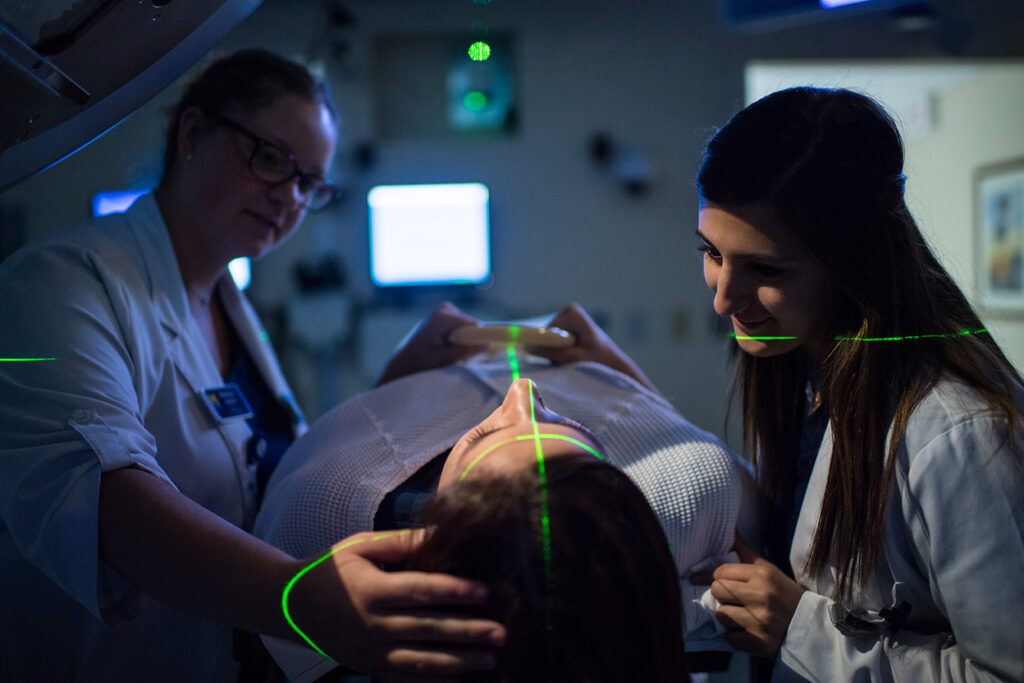
Through essential hands-on training in clinical settings, you acquire diverse skills and technological expertise, equipping you to enter the health care workforce and provide quality patient care.
Become a Radiation Therapist
The Bachelor of Science in Radiation Therapy degree program offers the evidence-based education and hands-on training required for a fulfilling career in health care. With your practical expertise and clinical skills, you can help physicians treat cancer and make a life-changing impact on patients and your community.
ON THIS PAGE
Why Choose UM-Flint’s Radiation Therapy Program?
Train with Cutting-Edge Technology
Because much of radiation therapists’ work incorporates operating machines, such as linear accelerators, in hospitals and outpatient centers, we prioritize this technical training as a crucial aspect of your professional development. Our classes combine evidence-based practices using the Virtual Environment Radiotherapy Trainer. This cutting-edge tool creates a 3-D virtual radiation treatment room where you can see inside a patient’s body and put your theoretical knowledge into practice.
Play a Part in Groundbreaking Research
To cultivate your curiosity, we offer a range of research opportunities through the Undergraduate Research Opportunity Program. Because much of radiation therapists’ work incorporates operating machines, such as linear accelerators, in hospitals and outpatient centers, we prioritize this technical training as a crucial aspect of your professional development. Our classes combine evidence-based practices using the Virtual Environment Radiotherapy Trainer. This cutting-edge tool creates a 3-D virtual radiation treatment room where you can see inside a patient’s body and put your theoretical knowledge into practice.
Get Hands-On Experience through Extensive Clinical Practicums
As a radiation therapy major at UM-Flint, you work with real patients with expert clinicians through clinical practicums. Thanks to the community partnerships U-M has cultivated, you can undertake clinical rotations with well-established partners, including Michigan Medicine, Corewell Health and Brighton Center for Specialty Care.
Receive Personalized Guidance
At UM-Flint, we believe that a strong sense of community has a long-standing impact on your education. That’s why we proudly boast a 14:1 student-to-faculty ratio. By keeping our class sizes small, we ensure you receive plenty of one-on-one instruction and mentorship from our renowned faculty. Their insight and seasoned expertise can help shape your career trajectory and enrich your experience as a U-M student.
Free Tuition with the Go Blue Guarantee!
UM-Flint students are automatically considered, upon admission, for the Go Blue Guarantee, a historic program offering free tuition for high-achieving, in-state undergraduates from lower-income households. Learn more about the Go Blue Guarantee to see if you qualify and how affordable a Michigan degree can be.

Curriculum Overview
The curriculum for UM-Flint’s BS in Radiation Therapy program offers a comprehensive undergraduate education comprising general education requirements and major-specific courses. Diversify your skills and clinical expertise through traditional coursework, collaborative learning experiences, practicums in medical facilities, and more.
During your first two years at UM-Flint, you enroll in prerequisite courses in human anatomy and physiology, health care ethics, medical terminology, pre-calculus mathematics, and physics. These fundamental classes lay the foundation for higher-level coursework, ensuring you have sound critical thinking skills and an understanding of the health care field.
After completing your prerequisite work, the advanced portion of your radiation therapy program begins the summer before your junior year. This segment lasts 22 consecutive months until April of your senior year and heavily focuses on your professional development. You take specialized courses that explore epidemiology, patient care and management, sectional anatomy in radiation therapy, technical radiation oncology, and radiation physics. Your studies culminate in clinical placements, allowing you to put your theoretical knowledge into practice and work closely with patients and other health care professionals.
Review the bachelor’s degree in Radiation Therapy curriculum for course descriptions and complete program requirements.
Career Outlook
With the U.S. population aging and the incidence of cancer rising, the demand for radiation therapists remains strong. As well-trained health professionals, radiation therapists provide safe, quality patient care while ensuring accurate treatment parameters and hospital protocols are followed.
The Bureau of Labor Statistics projects that employment of radiation therapists will grow by 2% through 2032, which is in line with other occupations. While radiation therapists’ salaries range from $72,280 to more than $136,910, this heavily depends on their level of education, experience, and location, along with various other factors.
$101,990
Median annual wage for Radiation Therapists
19,200
Number of jobs
Academic Advising
As a UM-Flint undergrad, you receive insightful guidance from our trusted advisors, who are ready to answer your questions and help promote your academic success.
Academic Advisor

Admission Requirements
There are two admissions processes for entrance into UM-Flint’s radiation therapy degree program, depending on whether you’re a high school student or a current college student.
Students will take general education and pre-professional courses in their first two years. The Radiation Therapy program is a cohort program that starts with two 3-credit courses in the summer semester of the junior year, followed by full-time study for the remainder of the junior and senior years.
Admissions Process for High School Students
If you’re a high school student interested in UM-Flint’s Radiation Therapy Direct Admission Program, you must:
- Be a high school senior applying for fall admission to UM-Flint.
- Have a minimum grade point average of 3.0.
When applying for direct admission, you must:
- Apply to UM-Flint as a pre-radiation therapy major by May 1.
- Submit the Supplemental Radiation Therapy program application by May 1. To request the application, email program director Julie Hollenbeck at hollenbj@umich.edu.
If you meet the requirements, we’ll invite you to attend Direct Admission Day, which is always the second Friday of May. On Direct Admission Day, you’ll be interviewed and complete a writing sample.
To prepare for your interview, we recommend increasing your knowledge of the radiation therapy profession before Direct Admission Day.
Once you receive an offer of direct admission, your seat in the radiation therapy program is reserved but not guaranteed. To secure your seat, you must:
- Complete all your college courses at UM-Flint. An exception is granted if you dual-enroll while in high school.
- Earn a minimum 2.70 GPA each semester and a 3.0 cumulative GPA at UM-Flint.
- Achieve a minimum 3.0 GPA in BIO 167, BIO 168, PHY 143, and PHY 145.
- Complete two eight-hour observations in a radiation oncology department.
- The seat is held for three years. Most students complete prerequisite courses in two years.
Admissions Process for College Students
If you are applying to the radiation therapy program and are currently a college student, you must complete general education and pre-professional courses with no grade lower than a C by the start of the summer semester in the year you intend to begin the program.
When you are ready to apply, you must complete the following by the Feb. 1 application deadline:
- If you are not already a UM-Flint student, complete the general admission application with radiation therapy as your field of study.
- Submit the supplemental radiation therapy program application. To request the application, email the program director, Julie Hollenbeck, at hollenbj@umich.edu.
- Submit three references.
- Submit documentation of 16 observation hours in an approved Radiation Therapy Department. To arrange observation, email Julie Hollenbeck at hollenbj@umich.edu.
- Take the ATI TEAS test before the Feb.1 application deadline. We recommend taking the ATI TEAS test after completing BIO 167 and BIO 168. Learn more about how to register for the ATI TEAS.
- Ensure you meet the Radiation Therapy Technical Standards set by the American Registry of Radiologic Technologists.
All application materials, including transcripts from other colleges and universities, must be received by Feb. 1 of the year you intend to begin the program. This deadline may be extended, provided the class has not reached its enrollment limit.
The following criteria are used for admission:
- Overall GPA.
- GPAs for BIO 167 and PHY 143.
- Completion of all general education and pre-professional courses with no grade lower than a C by the start of the first summer semester: ENG 112 (COMP), BIO 167, BIO 168, MTH 120, PHY 143, PHY 145, HCR 212, HCR 304, HCR 362, PSY 100, SOC 100, MTP 320, PHL 168 or 162, and one course in Fine Arts.
- Completion of observation hours.
- Submission of references.
- Demonstration of professionalism during advising sessions and required observations.
- Score of ATI TEAS admission exam.
- Interview score.
- Writing and problem-solving scores.
All qualified applicants will be contacted in February to schedule an interview and the writing and problem-solving test with the Admissions Committee. The interviews, conducted by a Radiation Therapy Review Committee, last approximately 40 minutes. At the interview, you’ll be asked 15 to 20 questions about your:
- Background and qualifications
- Interest in radiation therapy
- Work and life experiences
- Radiation oncology observations
Interview scores are based on your communication skills, ability to handle stressful situations, awareness of the duties of a radiation therapist, and overall qualities that would be useful in the program.
If you’re interviewed, you’ll receive an email and formal letter from the Radiation Therapy Department within two weeks advising whether you’ve been accepted or denied admission.
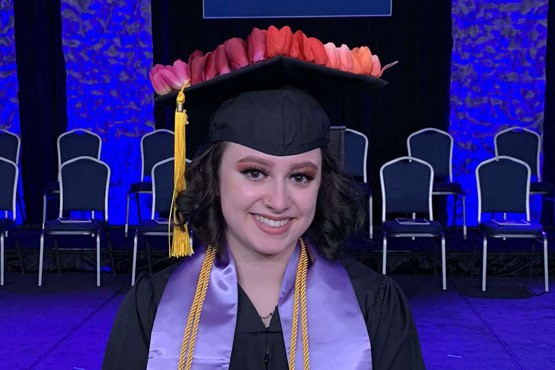
“I researched many potential occupations. After reaching out to the Radiation Therapy program director at UM-Flint, I knew it was the right choice for me. I enjoyed the togetherness of the program and the program director always made us feel seen and heard. I very much enjoyed gaining not only the knowledge but the people that came with it. I not only learned radiation therapy but also much needed communication skills that would help me succeed in the work environment. I received multiple job offers right after graduating and felt very prepared for the care I would deliver.”
Jasmine Amador
Radiation Therapy, 2022
Scholarships
At UM-Flint, we believe that a quality education can transform lives. Along with receiving financial assistance through the Office of Financial Aid, you can apply for a broad range of generous scholarships for College of Health Science students. Each one has unique requirements, so please carefully review scholarship details to ensure you qualify.
State Licensing
Each state administers licensing laws differently. Most states might require you to hold a state license to work there–even if you’re certified and registered with ARRT or licensed in another state. Contact each state individually for information and full requirements.
Accreditation
UM-Flint is accredited by the Higher Learning Commission, one of six regional accrediting agencies in the United States. The HLC is recognized by the U.S. Department of Education and the Council on Higher Education Accreditation.
The university’s current award is accredited, and the next reaffirmation is in 2029-2030. More information can be found on the Higher Learning Commission page.
Programmatic Accreditation
The Radiation Therapy program is accredited by the Joint Review Committee on Education in Radiologic Technology.
20 North Wacker Drive, Suite 2850
Chicago, IL 60606-3182
312-704-5300
Email: mail@jrcert.org
The program’s current award is Probation. General program accreditation information and the current accreditation award letter can be found on the JRCERT website.
Radiation Therapy Program Effectiveness Data
Current JRCERT Award Letter
Radiation Therapy Handbook