Master of Science in Physician Assistant
The Master of Science in Physician Assistant program at the University of Michigan-Flint aims to cultivate exemplary physician assistant practitioners, leaders, and advocates for the profession and public health through best practices in teaching, learning, and service to our diverse local community and beyond.
Social:
Program Outcomes and Preparation
With exceptional classroom, laboratory, and clinical training, the Physician Assistant Program arms you with strong medical knowledge and experience to successfully complete the National Commission on Certification for Physician Assistants exam and apply for state licensure. As a graduate of the Master of Science in Physician Assistant program, you are well-prepared to provide evidence-based patient care as an integral member of the interprofessional health care team.
Interested in visiting the UM-Flint campus and meeting with a current PA student? Schedule a visit to UM-Flint Campus Visit with PA program
On this page:
A Career in High Demand
Physician assistants diagnose illness, manage treatment plans, prescribe medications, and often serve as a patient’s primary health care provider. With an aging population and a growing need for care, demand for skilled PAs is rising fast.
#2
Ranked in Best Health Care Jobs by U.S. News & World Report.
#5
Ranked in the 100 Best Jobs by U.S. News & World Report.
20%
Projected growth in PA employment through 2034, much faster than average.
$133,260
Median annual salary for a physician assistant.
Why UM-Flint?
The World-Class U-M PA Program
The University of Michigan’s health care programs are nationally recognized. The Physician Assistant program on the Flint campus upholds this tradition with leading faculty, state-of-the-art facilities, and sought-after clinical experiences.
Exemplary Clinical Rotations
Students complete clinical rotations across Michigan Medicine, UM health affiliates, Genesee County hospitals, and Hamilton Community Health Center, with specialty rotation options. This robust training develops competencies in patient care, practice-based learning, and communication.
Mission
The mission of the UM-Flint PA program is to prepare students to become exemplary physician assistant practitioners, leaders, and advocates for the profession and public health through best practices in teaching, learning, and service to our diverse local community and beyond.
To achieve our mission, we will:
- Prepare a diverse PA workforce to serve the patient-centered needs and public health of the local, state, and national communities.
- Educate students to utilize evidence-based decision-making and problem-solving to enable safe, affordable practice of medicine in a changing health care environment, emphasizing self-assessment that promotes continuous improvement.
- Educate and encourage students to provide culturally competent and team-based care, committed to caring for all individuals.
- Prepare graduates who are creative leaders who advocate for and are civically engaged in their practice as clinicians, administrators, academicians, and researchers who contribute to the PA profession.
- Develop and support faculty members to achieve excellence in teaching, service, and scholarship.
- Support PA Program graduates and faculty in lifelong learning.
Curriculum
MS in Physician Assistant
The Master of Science in Physician Assistant program employs a comprehensive 103-credit curriculum to instill students’ medical knowledge and clinical skills through didactic and clinical phases. Cohorts of up to 50 students begin each January.
Over 28 months, students attend on-campus and online courses and experience a variety of clinical rotations. The first 16 months are didactic instruction-lecture and laboratory format with clinical immersions. The final 12 months are primarily clinical rotations with some online and on-campus requirements.
Clinical Arrangements
Students may suggest clinical sites and preceptors but are not required to provide or solicit sites for their clinical rotations. The UM-Flint PA program provides all clinical year students with clinical sites and preceptors that meet program requirements.
MS in Physician Assistant/MBA Dual Degree Option
The Master of Science in Physician Assistant /Master of Business Administration program is designed for ambitious PA students and graduates interested in Business and Health Administration. This dual program complements the MSPA program with business knowledge and skills to improve the effectiveness and operational success of health care organizations and to promote entrepreneurial initiatives by PA professionals to develop business solutions to everyday issues they observe in practice.
The degrees are independent, and the PA program must be completed first, followed by the completion of the MBA program. Each degree is awarded upon completion of the required credits for the MBA degree, after the MSPA degree is awarded.
Admissions
The UM-Flint PA program uses a holistic admissions process, evaluating each applicant on academic performance, health care and community experience, leadership, and alignment with the program’s mission and public-health emphasis. Review the full admissions philosophy, eligibility requirements, deadlines, and four-step application process on the Admissions page.

Bachelor’s of Science in Animal Science with a minor in Spanish from the University of Maryland, College Park
What are some of the best qualities of your program? The University of Michigan-Flint’s PA program has been incredibly rewarding for both my personal growth and personal development. The best qualities to me are the faculty and the clinical immersion experiences. The faculty are highly invested in their students, taking time to mentor us and instill confidence as future clinicians. Additionally, the clinical immersions have provided early, hands-on exposure that connects what we learn in the classroom to real patient care. Perhaps the most meaningful, though, has been the collaborative environment among classmates, being able to share knowledge with my peers while also learning from their unique backgrounds and perspectives, has enriched my understanding and prepared me to work effectively as part of a healthcare team.
Jade L.
Accreditation

The Accreditation Review Commission on Education for the Physician Assistant, Inc. (ARC-PA) has granted Accreditation-Continued status to the University of Michigan-Flint Physician Assistant Program sponsored by the University of Michigan. Accreditation-Continued is an accreditation status granted when a currently accredited program is in compliance with the ARC-PA Standards.
Accreditation remains in effect until the program closes or withdraws from the accreditation process or until accreditation is withdrawn for failure to comply with the Standards. The approximate date for the next validation review of the program by the ARC-PA will be July 2035. The review date is contingent upon continued compliance with the Accreditation Standards and ARC-PA policy.
The program’s accreditation history can be viewed on the ARC-PA website.
Program
- PANCE Pass Rates
- Program Student Attrition
- Estimated Cost of Attendance
- Program Competencies
- Program Goals
Program Policies
Admitted Student Data
U-M PA Class of 2026
cGPA: 3.59
pGPA: 3.68
Science GPA: 3.46
Average Age: 25
Average PCH: 1823
U-M PA Class of 2027
cGPA: 3.72
pGPA 3.70
Science GPA: 3.60
Average Age: 23
Average PCH: 2321
U-M PA Class of 2028
cGPA: 3.62
pGPA: 3.71
Science GPA: 3.56
Average Age: 25
Avg PCH: 3194
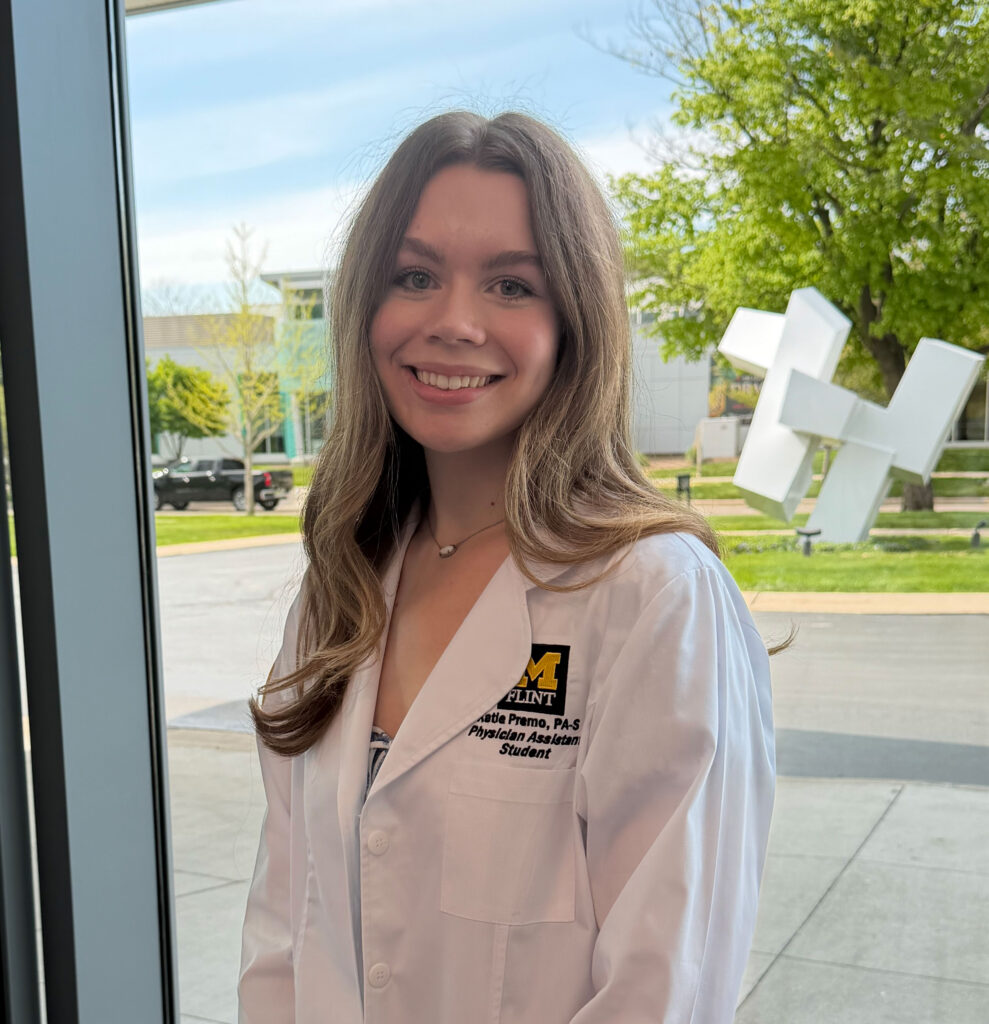
Bachelor’s degree in Human Biology, with a minor in Public Health
What are some of the best qualities of your program? One of the best qualities of the UM-Flint PA Program is the supportive culture among students, faculty, and the community we serve. All of the faculty members are encouraging, approachable, and genuinely invested in our success as individuals. As practicing PAs, they have great insight and help us connect tough concepts to real-world patient care. The program also brings in knowledgeable guest speakers from various specialties, providing valuable perspectives from experts in the field. I also appreciate the program’s emphasis on hands-on learning and community service. In addition, unique experiences such as cadaver anatomy labs and ultrasound training help reinforce our learning and prepare us for clinical practice. Overall, the program provides a supportive environment that helps students develop into well-rounded future PA-Cs!
Katie P.